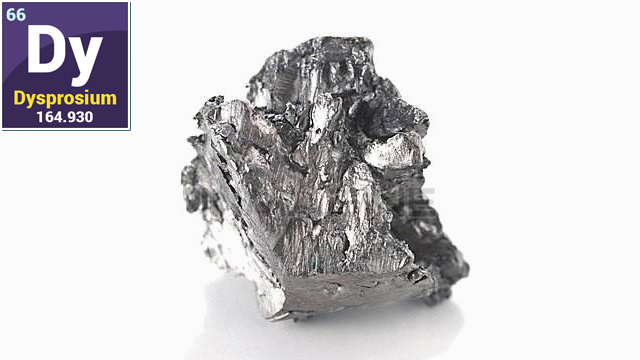
The rare earths are generally trivalent elements, but a few have other valences. Cerium, praseodymium, and terbium can be tetravalent; samarium, europium and ytterbium, on the other hand, can be divalent. Many introductory science books view the rare earths as being so chemically similar to one another that collectively they can be considered as one element. To a certain degree that is correct—about 25 percent of their uses are based on this close similarity—but the other 75 percent of rare-earth usage is based on the unique properties of the individual elements. Furthermore, a close examination of these elements reveals vast differences in their behaviours and properties; e.g., the melting point of lanthanum, the prototype element of the lanthanide series (918 °C, or 1,684 °F), is much lower than the melting point of lutetium, the last element in the series (1,663 °C, or 3,025 °F). This difference is much larger than that found in many groups of the periodic table; e.g., the melting points of copper, silver, and gold vary by only about 100 °C (180 °F).
The name rare earths itself is a misnomer. At the time of their discovery in the 18th century, they were found to be a component of complex oxides, which were called “earths” at that time. Furthermore, these minerals seemed to be scarce, and thus these newly discovered elements were named “rare earths.” Actually, these elements are quite abundant and exist in many workable deposits throughout the world. The 16 naturally occurring rare earths fall into the 50th percentile of elemental abundances. By the early 21st century, China had become the world’s largest producer of rare-earth elements. Australia, Brazil, India, Kazakhstan, Malaysia, Russia, South Africa, and the United States also extract and refine significant quantities of these materials.
Composition of selected rare-earth minerals| name | idealized composition | primary rare-earth content |
|---|
| allanite | (Ca,Fe2+)(R,Al,Fe3+)3Si3O13H | R = light lanthanoids |
| apatite | Ca5(PO4)3F | R = light lanthanoids |
| bastnasite | RCO3F | R = light lanthanoids (60–70%) |
| euxenite | R(Nb,Ta)TiO6 ∙ xH2O | R = heavy lanthanoids plus Y (15–43%) |
| fluorite | CaF2 | R = heavy lanthanoids plus Y |
| gadolinite | R2(Fe2+,Be)3Si2O10 | R = heavy lanthanoids plus Y (34–65%) |
| laterite clays | SiO2, Al2O3, Fe2O3 | R = heavy lanthanoids plus Y |
| loparite | (R,Na,Sr,Ca)(Ti,Nb,Ta,Fe3+)O3 | R = light lanthanoids (32–34%) |
| monazite | RPO4 | R = light lanthanoids (50–78%) |
| perovskite | CaTiO3 | R = light lanthanoids |
| sphene | CaTiSiO4X2 (X = ½O2−, OH−, or F−) | R = light lanthanoids |
| xenotime | RPO4 | R = heavy lanthanoids plus Y (54–65%) |
| zircon | ZrSiO2 | R = both light and heavy lanthanoids plus Y |